
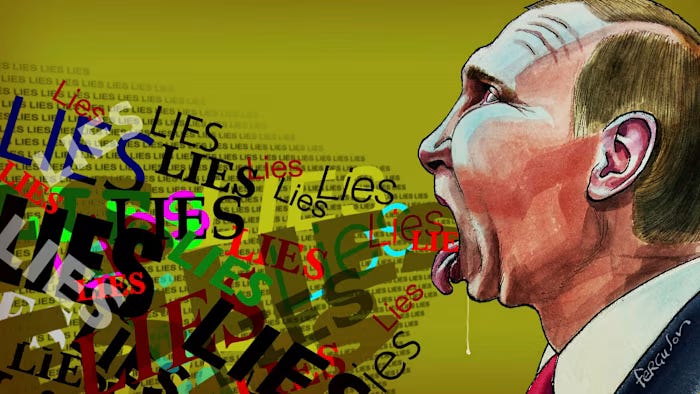
putin. LIES. ALWAYS.
Once KGB, always KGB: reflexive control and the war for the American mind

In chess, there’s a move called a fork. You attack two pieces at once, forcing the hand of your counterpart. Vladimir Putin relishes opportunities to fork his enemies. When ceasefire talks long dismissed as a cruel and pointless circus suddenly threatened to matter, he called Donald Trump and claimed that his Valdai residence, some 400 miles from the Ukrainian border, had been attacked. Why?
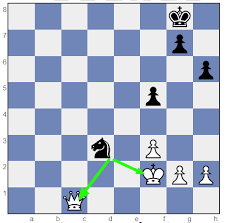
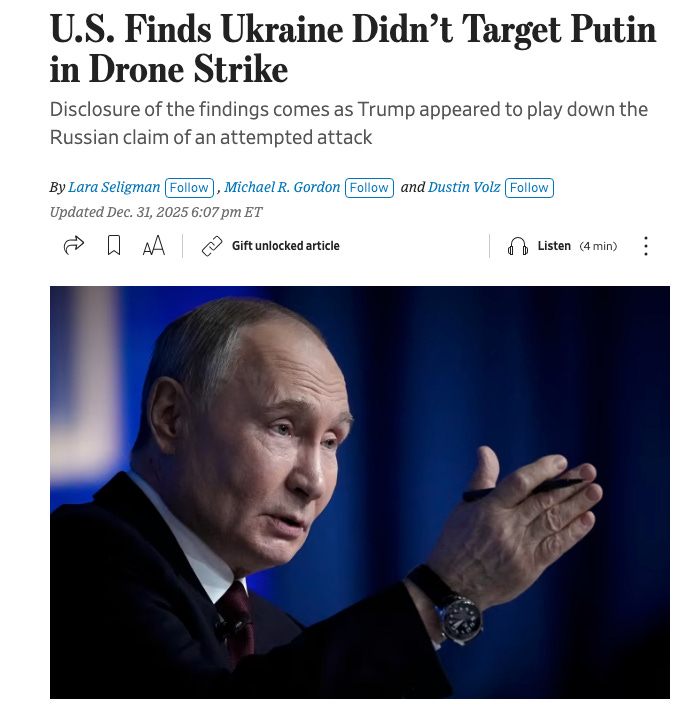
The story was a brazen lie and quickly collapsed. But that was beside the point. By telling it, an old KGB hand boxed the U.S. president into two bad options: confront the lie and respond forcefully to such overt disrespect, or ignore it and appear gullible, or worse – accommodating toward someone who had just insulted the office.
For Putin, shaped by decades in Soviet and Russian intelligence service, deception is the default setting. He does not negotiate. He manipulates. It is not that he dislikes dealmaking; it is that the idea barely registers. Lying comes easily and instinctively, and the person across from him is never a partner or an interlocutor, only an object to be used, misled, controlled, and exploited.
In 2001, George W. Bush famously described his interaction with the Kremlin ruler, who was then seen as a budding democrat, as follows: “I found him to be very straightforward and trustworthy [...] a man deeply committed to his country and the best interests of his country.”
In a resource-rich state where two-thirds of the rural population lacks indoor plumbing and more than a million men have been killed or wounded in a war of choice, Putin’s record points less to care for the nation than to the pursuit of power and the perpetuation of a bloodthirsty imperial order at all costs.
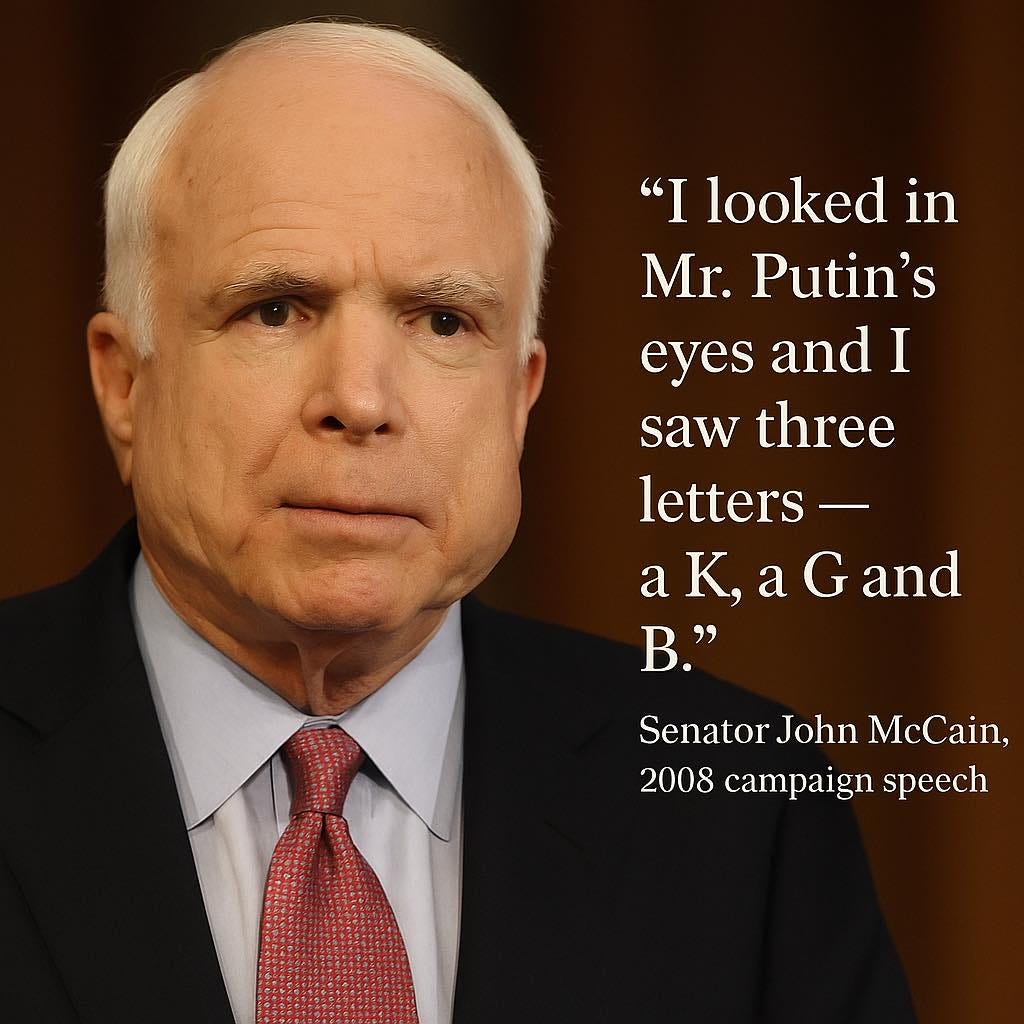
Obama attempted to engage Putin rationally and later dismissed him as “not so smart.” But it was John McCain who said it best: “I looked in Mr. Putin’s eyes and I saw three letters, a K, a G, and a B.”
To grasp the point of the Valdai lie, one has to understand reflexive control, a concept developed by Soviet intelligence to shape an opponent’s decision-making. It narrows your choices, so that every option carries a cost.
Putin lied about troops in Crimea. Lied about Russia’s intentions in Ukraine. And he’ll keep going because, as the Institute for the Study of War explains, “The Russian way of war is centered on the notion that wars can be won and lost in the opponent’s mind.”
Putin also preyed on Trump’s desire to be seen as a peacemaker. In early 2025, Ukraine took just 24 hours to agree to a ceasefire proposed by the White House. Publicly, the Kremlin claimed to be relentlessly pursuing peace. In reality, it intensified its criminal war. Attacks on civilians increased, North Korea confirmed that its troops are fighting for Russia, and negotiations turned into farce. The Nobel Peace Prize never arrived, and Putin wasted little time gloating.
The Alaska summit exposed the same pattern. The Russian dictator gained a platform to repeat his lies, and Ukraine was excluded from talks about its own future. Putin gave nothing. No ceasefire, no withdrawal, no accountability.
As the former commander of the Ukrainian armed forces Valerii Zaluzhnyi wrote: “Russia’s negotiators, like its generals, fight to exhaust, confuse and divide. Their aim is not peace but delay; not compromise in pursuit of accord but conquest through deception.”
This approach is well documented. As Casey Michel has shown in his analysis of Russian wartime narratives, Moscow’s objective is not coherence or credibility but psychological dominance. The Kremlin’s strategy relies on flooding the zone with contradictions, half-truths, and outright lies, forcing adversaries to react – not act.
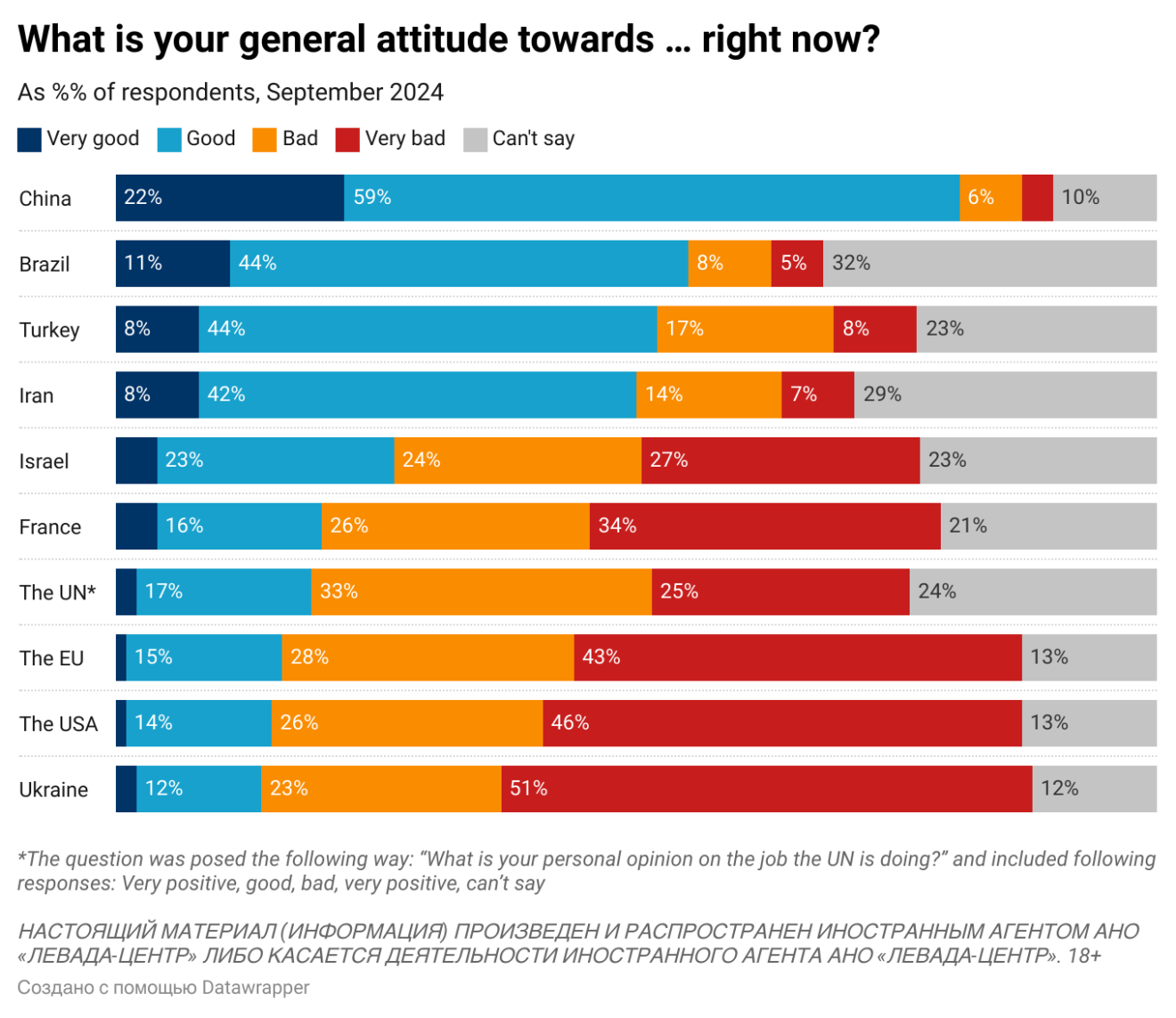
The Putin who signals affinity toward Trump is the same Putin who has spent a quarter century turning anti-Americanism into state doctrine. Under Gorbachev and Yeltsin, roughly 70% of Russians viewed America as a friend. Today, about three-quarters see us as the enemy.
Then there’s the nuclear blackmail. Russia didn’t use its doomsday weapons when its army collapsed outside Kyiv, when Ukraine liberated Kherson, when Crimea came under attack, or when Ukrainian troops crossed into Kursk Oblast. Ultimately, the biggest factor here is that Xi Jinping, to whom Putin now effectively reports, has ruled nukes out.
Perhaps Putin’s boldest lie is that Russia can be lured away from China if the West lets him have Ukraine. The so-called “marriage of convenience” hardened into a “no limits” partnership the moment the invasion began. China now supplies 92% of the foreign components in the drones Russia uses to strike Ukrainian cities. Letting Russia prevail would not loosen that bond. It would reward Moscow for choosing Beijing.
So why does Putin lie to Trump? Because lying is what Putin does, and because he believes it works.
The first step to defeating Russian cognitive warfare is simple: stop playing by Russia’s dirty rules. Stop accepting Putin’s framing. Stop reasoning from false premises. The second step is harder: give Ukraine what it needs to kick the invaders out. Show Putin that attempts to take Ukraine’s freedom, deceive the U.S. president, and threaten nuclear escalation will not be tolerated.
Putin lies out of habit, but also out of fear. He lies because his military is underperforming even the lowest expectations and Russia’s economy is faltering. Putin lies because his only path to victory runs through Washington’s self-deterrence and Europe’s indecisiveness. The greatest lie of all is that we have no choice but to accept it.
An excellent piece, Andrew. Americans in particular seem far too trusting of the criminals in the Kremlin.
A question for you: is "vranyo" as important a concept to understand as "reflexive control"?
I suspect that it is but I'd appreciate your insight.
Perun - "How lies destroy armies - Lies, coverups, and Russian failures in Ukraine"
https://www.youtube.com/watch?v=Fz59GWeTIik
"The Russian language has two different words for what most European languages would describe as lies. One is lozh (ложь), best translated into what we consider to be a lie; something that is the opposite of the truth. There is also vranyo (враньё). Vranyo is more than a simple lie. It is described as: ‘You know I’m lying, and I know that you know, and you know that I know that you know, but I go ahead with a straight face, and you nod seriously and take notes.’[7]"
https://militairespectator.nl/artikelen/vranyo
go fight on the front lines then or stfu